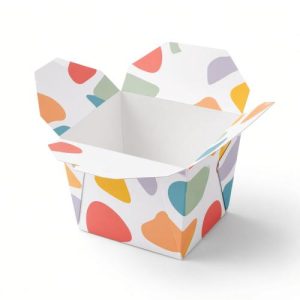
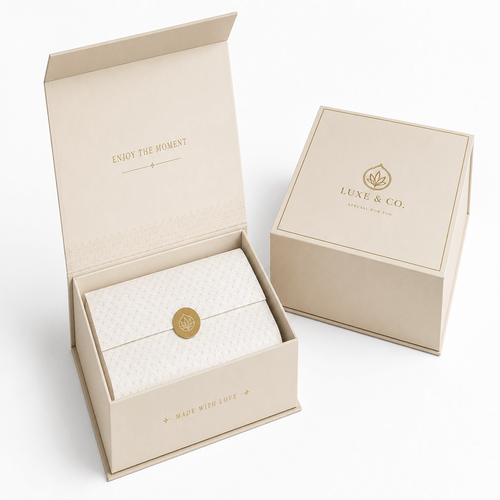
In the gift packaging industry, consumers often focus first on visual design. In actual use, however, box compression resistance and opening/closing convenience are what truly determine user experience. The foldable multi-layer structure provided by Xingmao Paper Products reveals the technical balance point between visual presentation and functional performance in industrial packaging.
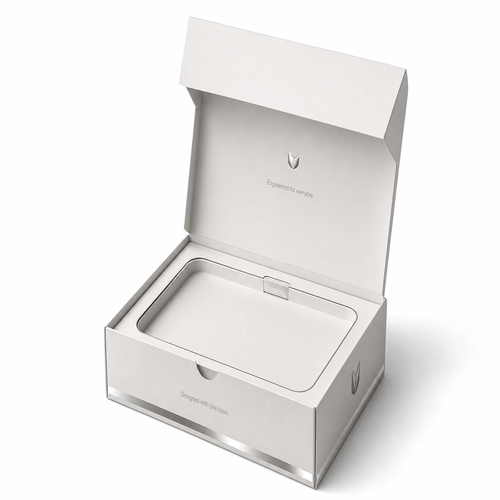
Working Principle and Core Structural Analysis
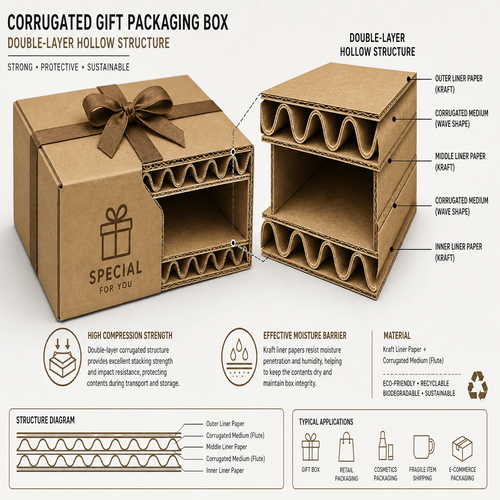
The 200–300 gsm paper range forms the basic supporting framework: 200 gsm is suitable for lightweight electronics packaging, while 300 gsm is better for scenarios that require transport protection. Its moderate stiffness comes from the sandwich structure of corrugated board—through composite bonding of a wave-shaped medium and flat liner papers, vertical compression strength can be improved by more than 30% without significantly increasing weight (based on industry test data). Foldable performance depends on pre-pressed crease-line processing. These micron-level precision grooves guide the paper to bend along predetermined paths, preventing random cracking.
How Technical Differences Affect Real-World Application
The difference between single-layer and multi-layer structures is reflected in environmental adaptability: single-layer boxes are more suitable for short-term use in dry indoor environments, while double-layer hollow versions can effectively block moisture penetration. Different paper weights also show clear differences in folding life—200 gsm material can withstand around 50 opening/closing cycles (e.g., cosmetics trial-size scenarios), while 300 gsm material is recommended to stay within about 20 cycles to maintain crease precision. The use of recyclable materials may slightly reduce surface print resolution, but it can meet EU REACH migration-limit requirements for packaging.
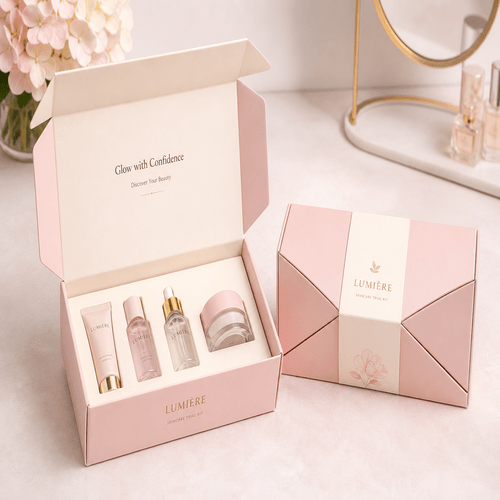
Application Scenarios and Decision Framework
Selection should be based on a three-dimensional evaluation model: in transport, focus on corrugated layer count (related to drop-test pass rate); in retail, assess unfolding/storage efficiency (units processed per hour); in warehousing, calculate stacking load capacity (static load ≥ 8 kg per box). For engraved customization needs, 250 gsm or above is recommended to reduce carbonization risk during laser engraving. Users in humid regions should verify whether waterproof coating coverage at box seams reaches above 90%.