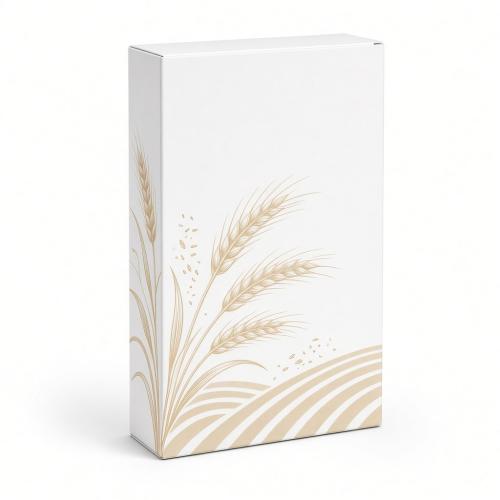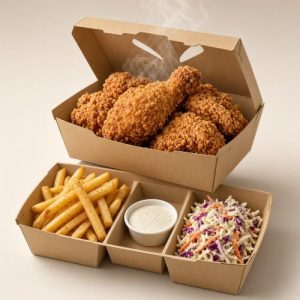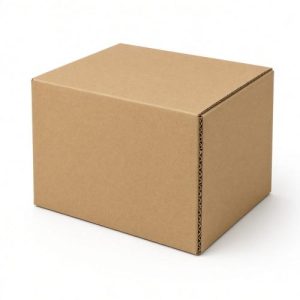
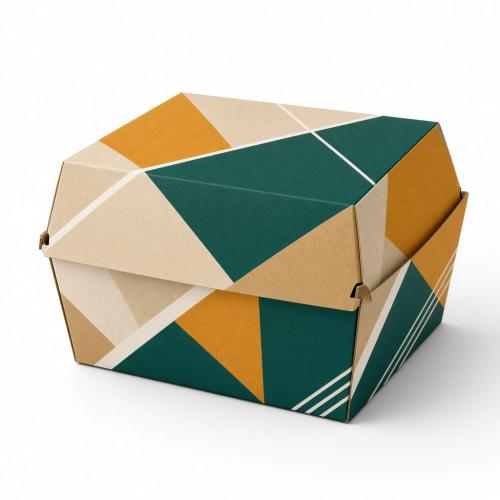
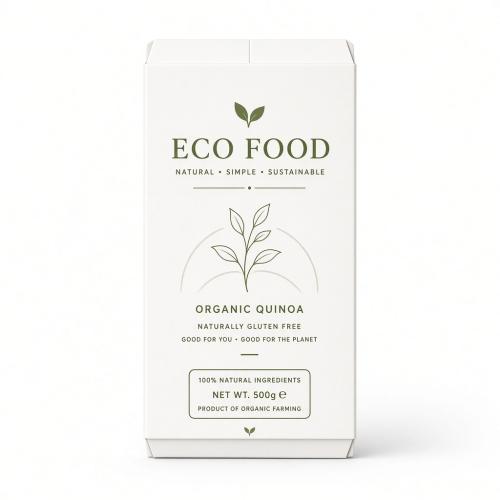
Food packaging boxes are a key link in the food industry supply chain. Their core function is to ensure product safety during transportation, storage and retail, while enhancing market appeal through physical protection and visual packaging. For dry goods such as wheat-flour products and sheet noodles / starch noodles, custom packaging must balance load-bearing and compression resistance, moisture barrier performance, printing precision and cost control.
Core Technologies and Printing Processes of Food Packaging Boxes
The performance of food packaging boxes depends on the combination of paper material and printing technology:
1. Material and Physical Structure
- Board specification: 230 GSM high-basis-weight board, with a multi-layer composite structure that significantly improves compression and tensile strength.
- Structural design: Glue-free fold-to-form structure, no chemical adhesive required, directly complying with food-contact safety standards.
- Dimensional accuracy: Batch production error strictly controlled within ±0.5 cm.
2. Six Mainstream Printing and Surface Treatment Processes
- Offset Printing: Suitable for large-area background printing and delicate gradient color transitions.
- Screen Printing: Achieves local thick ink layers for a tactile, three-dimensional texture.
- UV Printing: Uses ultraviolet light to instantly cure ink, greatly improving pattern abrasion resistance and scratch resistance.
- Foil Stamping (Gold/Silver): Metallic finish highlights the brand LOGO and core selling points, enhancing visual recognition.
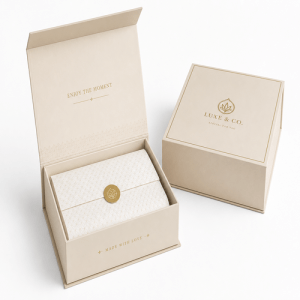
- Embossing / Debossing: Presses three-dimensional text or patterns on the cover to upgrade the packaging’s premium feel.
- Flocking: Electrostatic adsorption of short fibers creates a velvet touch, often used for high-end gift boxes.
II. Core Technical Specifications and Quality Control Standards
To ensure safety for cross-border export and bulk transportation, food packaging boxes must meet the following quantifiable physical and environmental parameters:
| Test Item / Parameter | Standard Value / Indicator | Application Scenario and Function Description |
|---|---|---|
| Paper Weight (GSM) | 230 GSM | Basic load-bearing and anti-deformation guarantee |
| Tensile Strength | ≥ 3.5 kN/m | Prevents tearing and stretching deformation during transport |
| Bursting Strength | ≥ 2.5 kPa | Withstands stacking and compression pressure |
| Color Tolerance | ΔE ≤ 3 | Strictly meets international color-chart standards, ensures brand-color consistency |
| Minimum Legible Font Size | 3 pt | Ensures micro text such as ingredient lists and nutrition labels remain clear and readable |
| Board Recyclability | ≥ 90% | Complies with FSC forest certification and circular-economy requirements |
| VOCs Emission Reduction Rate | 70% | Water-based ink replaces traditional solvent-based ink |
| Degradation Period | Fully decomposes within 6 months | Decomposition time of degradable coating in natural environment |
III. Custom Solutions by Food Type
For different physical properties of foods, packaging boxes require targeted functional enhancements:
- Moisture-sensitive types (e.g., sheet noodles, dry pasta): Add PE lamination or food-grade waterproof coating on the inner layer to block ambient humidity and extend shelf life.
- Brand-showcase types (e.g., premium wheat noodles, specialty gift boxes): Combine embossed text with foil stamping; support single-color to four-color gradient LOGO printing to accurately convey the brand story.
- Flexible supply chain (e-commerce and cross-border export): Production capacity up to 50,000 pcs/day, meeting bulk-order needs of platforms such as Amazon and Walmart. Low MOQ sample trial production is supported to help new products test the market quickly and reduce inventory risk.
IV. Global Compliance Certifications and Environmental Sustainability
Food packaging boxes must comply with strict regulatory requirements:
- EU CE Certification: Strictly limits heavy metals and harmful substances in packaging materials.
- US FDA Standard: Passes extraction and migration tests for food contact materials (FCM) to ensure non-toxic and harmless.
- FSC Forest Certification: Raw materials come from sustainably managed forest resources.
- Eco-friendly water-based ink: Reduces volatile organic compound (VOC) emissions at the source.
V. FAQ
Q1: How to choose the right material for dry-pasta food packaging boxes?
A: It is recommended to use 230 GSM or higher board with an inner PE lamination for moisture resistance. This ensures compression resistance during transport stacking (bursting strength ≥ 2.5 kPa) while effectively blocking moisture.
Q2: Can food packaging boxes directly contact food?
A: Yes. But they must use a glue-free fold-to-form structure and food-grade materials / water-based coatings that comply with US FDA or EU standards, avoiding contamination from chemical adhesives or heavy-metal migration.
Q3: What compliance requirements do e-commerce platforms (e.g., Amazon) have for food packaging boxes?
A: Export to the EU requires CE certification (heavy-metal restrictions); export to the US must meet FDA food-contact-material testing. Also, FSC-certified materials are recommended to meet overseas consumers’ preference for eco-friendliness (recyclable / biodegradable).