Packaging Engineer’s Guide: Physical Performance, Cold-Chain Drop Limits, and Automation Compatibility of 3mm Single-Wall (B/E Flute) Corrugated Boxes
Executive Summary
The reliability of corrugated transit packaging is determined not by nominal cardboard thickness or color, but by the precise alignment of structural mechanics (flute profiles and fold design), material engineering (moisture-resistant inks and paper moisture content), and supply chain conditions (cold-chain drops and automated stacking). A 3mm single-wall corrugated box, engineered with tight dimensional tolerances (±0.05 mm), provides an optimal strength-to-weight ratio for automated fulfillment lines. However, its single-wall structural limits must be clearly defined under high-humidity drop scenarios.
1. Physical Specifications & Material Mechanics
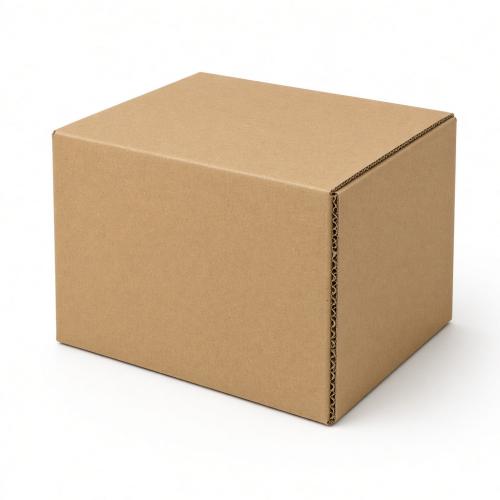
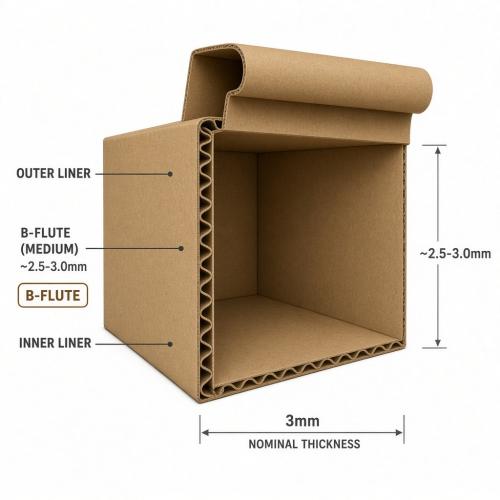
Single-wall corrugated board consists of an outer liner, an arched fluted medium, and an inner liner. A 3mm profile typically corresponds to B-Flute (flute height ~2.5–3.0 mm) or E/B micro-flute combinations, offering high flat-crush resistance and a smooth surface for precision printing.
| Technical Parameter | Specification / Trait | Supply Chain & Operational Impact |
|---|---|---|
| Board Structure | 3mm Single-Wall (B-Flute or E-Flute) | High flat-crush strength and flat printing surface; shorter cushioning stroke compared to 5mm double-wall boards. |
| Manufacturing Tolerance | ±0.05 mm Die-Cutting Precision | Ensures square box assembly, drastically reducing jams on automated unboxing and sealing machinery. |
| Print Coating & Ink | Moisture-Resistant Water-Based / UV Inks | Prevents condensation penetration during cold-chain temperature transitions, avoiding ink smearing and board softening. |
| Cold-Chain Resistance | Fiber Embrittlement & Moisture Sensitivity | Low temperatures increase paper brittleness. Single-wall energy absorption is lower than double-wall structures under repeated high-drop impacts. |
2. Impact of Technical Factors on Practical Logistics
Structural Mechanics & Drop Limits
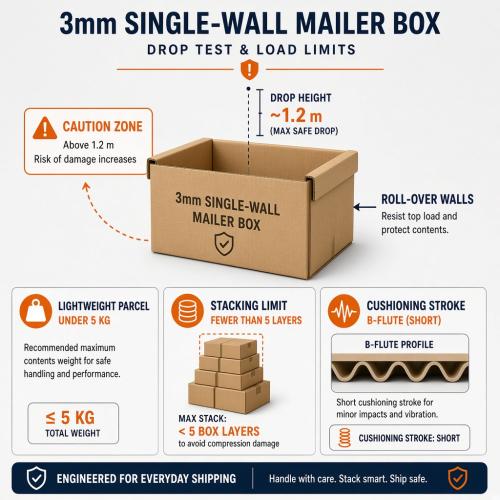
- Arch Cushioning Mechanics: Roll-over side walls on die-cut corrugated box designs provide double-layer vertical edge support, yielding higher top-load resistance than standard RSC (Regular Slotted Containers).
- Drop Impact Limits: Due to the limited flute height of 3mm single-wall board, its stroke length for deformation energy absorption is short. For logistics routes involving violent sorting or drop heights exceeding 1.2 meters, 3mm single-wall corrugated boxes are recommended as inner packaging or for lightweight direct parcel shipments (<5 kg / 11 lbs).
Material Behavior in Cold-Chain Environments
- Low Temperature & Humidity Effects: Corrugated paperboard loses moisture and becomes brittle in cold storage, while absorbing condensation during ambient transit, which can reduce stacking strength by 30%–50%.
- Moisture-Resistant Inks & Coatings: Specialized water-resistant UV inks or varnish layers act as a barrier, delaying moisture ingress into the corrugated core and preserving structural stiffness.
Compatibility with Automated Packing Lines
- Dimensional Precision: A ±0.05 mm die-cutting tolerance maintains strict blank consistency. This enables smooth suction pickup, precise score bending, and error-free sealing on high-speed packaging equipment.

3. Engineering Selection Framework
To evaluate whether a 3mm single-wall corrugated box fits your application, apply this three-tier decision framework:
- Logistics Stress Assessment:
- Suitable: Short transit legs, low stacking height (<5 layers), and lightweight payloads (e.g., cold-chain meal kit inner boxes, cosmetics, consumer electronics, apparel).
- Unsuitable: Unbuffered heavy payloads shipped directly without secondary protection (upgrade to 5mm double-wall BC-flute boxes).
- Surface Protection Requirements:
- For cold-chain or high-humidity regions, specify moisture-resistant UV printing or protective aqueous varnish.
- Automated Equipment Matching:
- Verify that die-cut tolerances match auto-folder equipment specifications (recommended tolerance ≤±0.1 mm; ±0.05 mm delivers optimal uptime).
4. Frequently Asked Questions (FAQ Schema)
Q1: Why should cold-chain box selection go beyond cardboard thickness and kraft color?
A1: Thickness and paper color do not directly correlate with crush resistance or moisture protection. Cold-chain performance depends on the strength degradation rate under low-temperature, high-humidity conditions. Structural flute geometry (such as high flat-crush resistance in B-flute), moisture-resistant inks, and fold mechanics prevent box collapse far better than merely increasing paper thickness.
Q2: Can a 3mm single-wall corrugated box be used directly as an outer cold-chain shipping container?
A2: Yes, provided the parcel uses internal support structures (like ice packs or EPS inserts), carries lightweight payloads (<5 kg), or moves through low-impact fulfillment networks. For heavy produce or frozen meats shipped bare, double-wall corrugated boxes are recommended for higher stacking strength.
Q3: What is the economic impact of a ±0.05 mm die-cutting tolerance?
A3: While manual assembly sees finer fit and finish, automated packaging lines benefit directly: a ±0.05 mm precision tolerance eliminates feeding misalignments and machine jams, maximizing line speed and reducing equipment downtime costs.