Why Custom Boxes Need Attention to Material and Craftsmanship? — Understanding Customization Logic from a Structural Design Perspective
When you customize a box, the core is not the box itself, but how its material and structure precisely match your cargo protection needs. A box is not “the thicker the better”; what really matters is the flute profile, number of layers, and die-cutting accuracy of the corrugated board—these directly determine the balance between compression strength and cost.
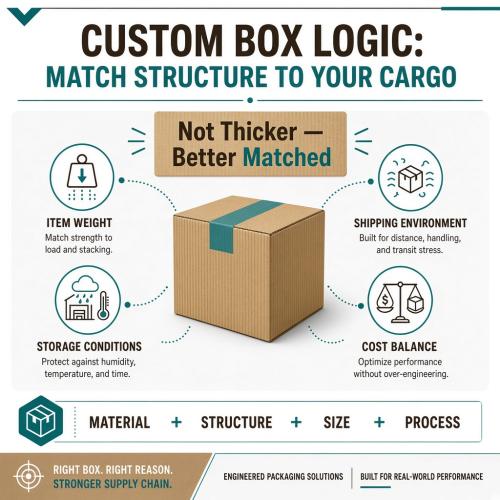
When users search for “custom boxes,” their core need is usually not to learn about boxes per se, but to understand which factors in the customization process affect a box’s performance and suitability. The essence of custom box making is to design the material, structure, size, and process of the box according to the weight of the packaged item, shipping environment, storage conditions, and other factors. The common industry view is that thicker is not necessarily better—the box must match actual needs, otherwise it may lead to wasted cost or insufficient protection.
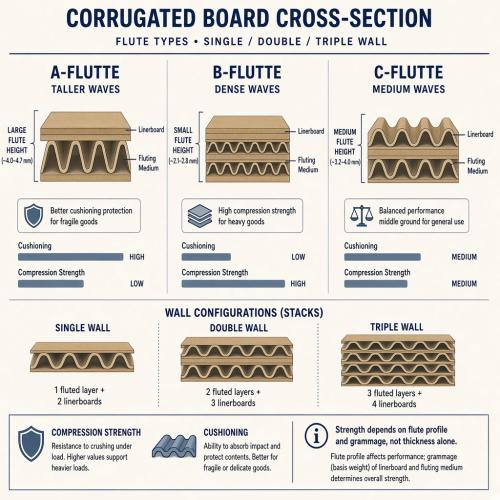
A box’s protective performance mainly depends on its material and structural design. Take common corrugated board as an example: it is formed by pressing linerboard, fluting medium, and backing paper through corrugated rolls. The flute shape (such as A-flute, B-flute, C-flute) and number of layers (single-wall, double-wall, triple-wall) directly determine the box’s compression strength and cushioning ability. For instance, A-flute has greater flute height and better cushioning, suitable for fragile items; B-flute is denser and has higher compression strength, suitable for heavy goods. Choosing corrugated material for custom boxes is essentially balancing compression, cushioning, and cost. In addition, a box’s “thickness” (e.g., 0.3 mm) usually refers to total board thickness, but actual strength depends more on flute profile and paper grammage than on thickness alone.
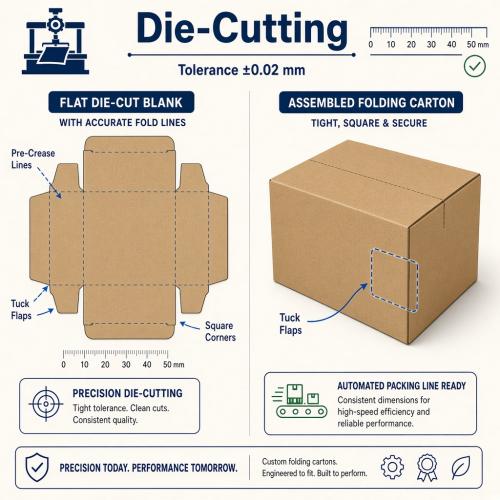
In customization, die-cutting is a key process. Die-cutting uses a die to cut the board into specific shapes and sizes; its accuracy directly affects box formation quality and sealing. For example, keeping error within 0.02 mm means fold lines and cut positions are accurate, so the folded carton stays square with tight corners, avoiding unstable stacking or product movement caused by dimensional deviation. Folding carton designs usually include pre-crease lines and tuck flaps; these structures require precise die-cutting to enable fast assembly and secure locking. Industry requirements for die-cutting accuracy are often tied to compatibility with automated packing lines—high-precision die-cutting reduces manual adjustment time and improves packing efficiency.
Custom box applications vary widely, so the focus differs. For express/logistics scenarios, boxes must withstand repeated handling and stacking; compression strength and burst strength are the top metrics. Three-ply or five-ply corrugated board is commonly used, and the flute direction should align with the main load direction. For small items or inner packaging, dimensional accuracy and surface print quality matter more; customization should define internal clearance to avoid being too loose or too tight. Also, a box’s net weight (e.g., 0.4–0.6 kg) reflects material usage, but heavier is not better, since overweight boxes raise shipping costs. Once these differences are understood, users can discuss specific material, flute type, die-cutting accuracy, and printing requirements with suppliers to get a custom solution balanced in performance and cost.
Custom box applications vary widely, so the focus differs. For express/logistics scenarios, boxes must withstand repeated handling and stacking; compression strength and burst strength are the top indicators, and three-ply or five-ply corrugated board is typically chosen, with flute direction aligned with the force direction. For small goods or inner packaging, size accuracy and surface printing quality are more critical; customization should clarify internal space allowance to avoid being too loose or too tight. Moreover, the box’s net weight (e.g., 0.4–0.6 kg) reflects board usage, but heavier is not necessarily better because it increases shipping cost. After understanding these differences, users can communicate specific material, flute type, die-cutting accuracy, and printing requirements with suppliers to obtain a customized solution that balances performance and cost.