Custom Hardcover Boxes: How Hot Stamping, Embossing/Debossing, and UV Coating Affect Actual Packaging Performance
The final look of a hardcover box is not determined by the design file alone. It is the combined result of material composition, surface finishing, and processing methods. Understanding why these processes exist and how they work together is more practically meaningful than simply comparing visual effects.
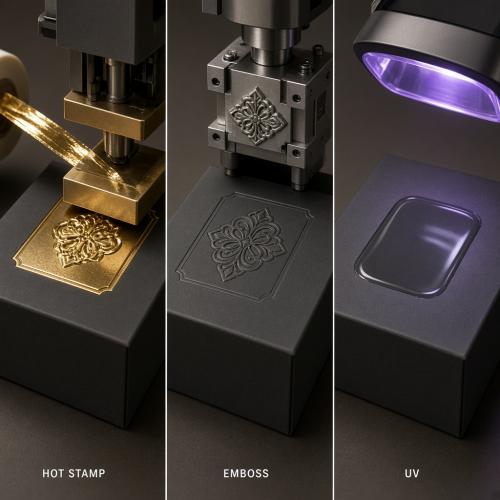
In packaging printing, custom hardcover boxes are often seen as a direct representation of a product’s image. When buyers first encounter such products, they usually focus on whether the appearance looks refined and whether the colors are vivid, while easily overlooking a key fact: the final performance of a hardcover box is not decided by the artwork alone, but by the interaction of materials, surface treatments, and manufacturing processes. The same hot stamping, embossing, and UV coating can show very different texture, durability, and consistency depending on the structural layers and the sequence of processes. Understanding why these processes exist and how they complement each other is more valuable than comparing visuals alone.
Working Principles and Core Structure
Custom hardcover boxes usually use composite materials as the base structure. These materials are made of multiple substrate layers with different properties, balancing rigidity, flatness, and printability. What sets hardcover boxes apart from ordinary folding cartons is their more complex layering: the outer wrapping paper handles visual presentation, the gray board or composite board provides support, and the inner lining affects touch and protection. This multi-layer structure means that during production, the response differences of each material layer must be considered.
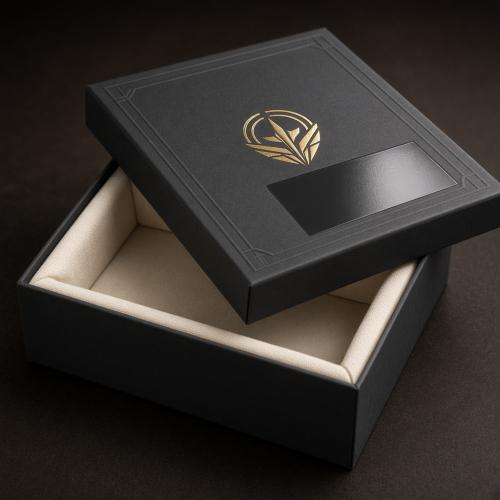
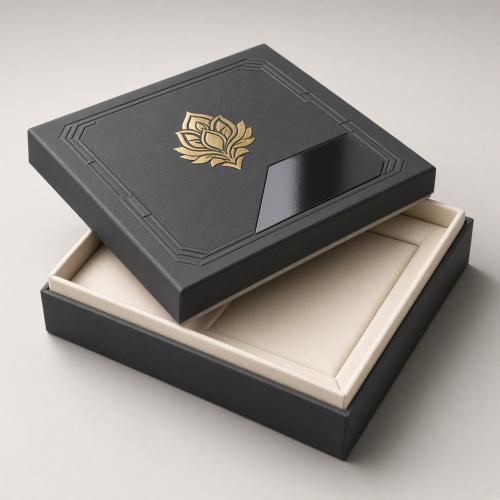
Hot stamping transfers metallic foil onto the substrate using heat and pressure. Its result depends on the match of temperature, pressure, and dwell time. Different composite surfaces have different sensitivities to stamping parameters; if settings are wrong, the foil may adhere poorly or show blurred edges.
Embossing uses male/female dies to create a three-dimensional relief on the material surface. It is not just decoration—it changes the local stress distribution of the material. The height of the relief and the precision of the die directly affect how clear and long-lasting the 3D effect is.
UV coating applies a ultraviolet-cured layer to specific areas to create high gloss or special texture. The order in which UV is combined with hot stamping and embossing affects the final surface flatness and sense of depth. The cooperation between professional machines and skilled operators is especially critical here: machines ensure repeatability and batch consistency, while operators handle die adjustment, material adaptation, and in-process inspection. Neither can be omitted.
How Technical Differences Affect Real Applications
Differences in process combinations and sequences first show up in surface stability. If the hot-stamped layer does not adhere well, it may peel or scratch during subsequent die-cutting, folding, or shipping friction. This is directly related to the coating property of the composite surface and the stamping parameters.
Whether the embossed effect holds its shape depends on how well the die design matches the material’s spring-back behavior. If the raised area receives wrong pressure in later processes, the dimensional feel weakens.
The gloss uniformity of UV coating is affected by coating thickness and curing energy. Excessively thick spots or insufficient curing cause visible surface differences.
These differences are not simply “good vs. bad.” They are trade-offs among stability, consistency, and maintenance requirements. For example, a hardcover box with multiple overlapped processes looks richer in layers, but needs longer waiting times between steps and tighter parameter handovers, with more quality-control points. A simpler process is easier to control in batch consistency, but offers limited surface expression. Understanding where these differences come from helps confirm which steps matter most when discussing custom requirements.
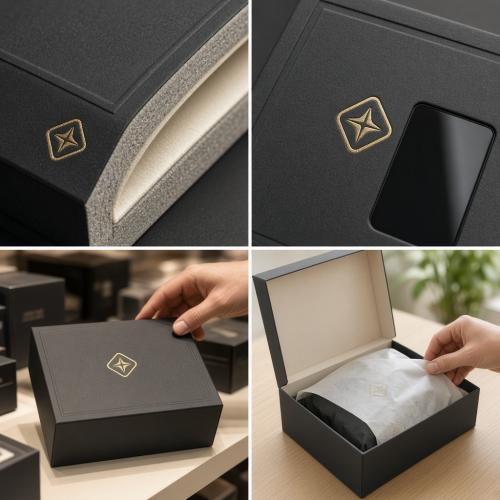
Application Scenarios and Evaluation Framework
Custom hardcover boxes serve very different scenarios. They should be evaluated from a few concrete dimensions:
First, pay attention to the match between material structure and process. The top-layer property of the composite material determines how well hot stamping and UV adhere, and also affects embossing formation. Before customization, confirm that the material combination fits the chosen processes.
Second, check the overlay sequence and precision requirements. The order of hot stamping, embossing, and UV affects surface depth and three-dimensional feel. The level of machine-operator coordination decides consistency across batch units.
Third, judge the actual demands of the usage environment. Sales packaging and end-user packaging face different friction, light exposure, and humidity during transport, display, and consumer handling, so the focus on foil adhesion and UV coating durability differs.
Fourth, understand the relationship between customization depth and communication cost. When style, size, logo, and color are all selectable, flexibility is high—but every added variable means more communication in sampling and parameter confirmation. Under a one-stop service model, acceptance standards for each stage should be clearly defined.
Building these observation dimensions makes it easier to judge whether a hardcover box truly fits your product positioning and usage conditions, rather than just comparing appearances.
Application Scenarios and Evaluation Framework (recap)
Custom hardcover boxes vary widely by application. Evaluate them by:
1. Material–process compatibility;
2. Process sequence and machining accuracy;
3. Environmental demands on surface finishing;
4. Customization depth vs. communication cost, with clear acceptance criteria in one-stop services.
Establishing these dimensions helps determine fit better than visual comparison alone.