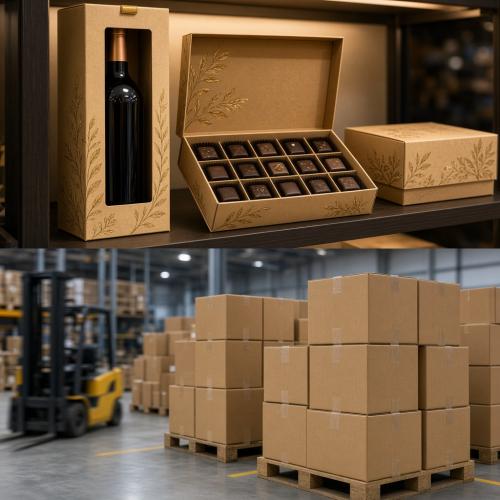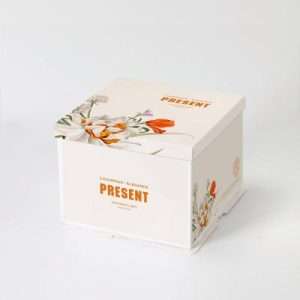
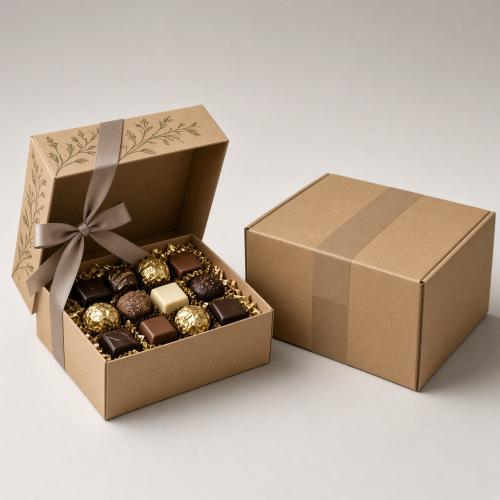
Want a chocolate gift box packaging that stands out while staying practical? The key lies not only in a beautiful appearance, but also in the choice of paper material and structural craftsmanship. Kraft paper offers fine printing and is ideal for display; corrugated paper provides compression resistance and cushioning, making it great for shipping. Understanding the characteristics of paper and the differences in die-cutting processes ensures that the packaging remains stable and reliable during display, stacking, and logistics.
In the selection process for paper-based packaging such as chocolate gift boxes, many users tend to focus first on the color matching and pattern clarity of the exterior design, while easily overlooking the impact of paper material and structural craftsmanship on actual packaging performance. In fact, the type of paper (such as kraft paper vs. corrugated paper) and the differences in die-cutting processes directly determine the load-bearing capacity, anti-deformation performance, and print adaptability of the paper box—and these are the factors that decide whether the packaging can function reliably in industrial production and logistics.
Working Principle and Core Structure Analysis
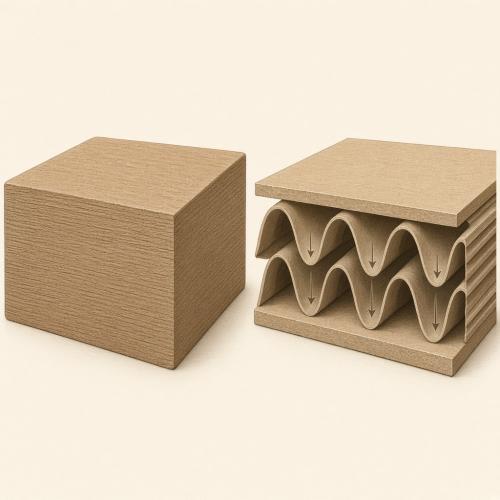
The core function of paper box packaging is to contain the product and withstand external forces during transportation and stacking. Kraft paper, with its long fibers and high strength, is often used for the surface layer or single-layer structure of boxes that require high tear and tensile resistance. Corrugated paper, through the wave-shaped bonding structure of fluting and liner papers, forms a mechanics support similar to an I-beam, greatly enhancing the compression resistance and cushioning ability of the board. The die-cutting process uses a mold to precisely cut and crease the cardboard or corrugated board, allowing the box to be folded quickly into shape while maintaining structural stability. The fiber characteristics of different papers and the flute type of corrugation (such as A, B, E flute) determine the rigidity, cushioning performance, and printing surface smoothness of the box, while die-cutting precision affects the squareness of the formed box and the fit of the opening.
How Technical Differences Affect Practical Application**
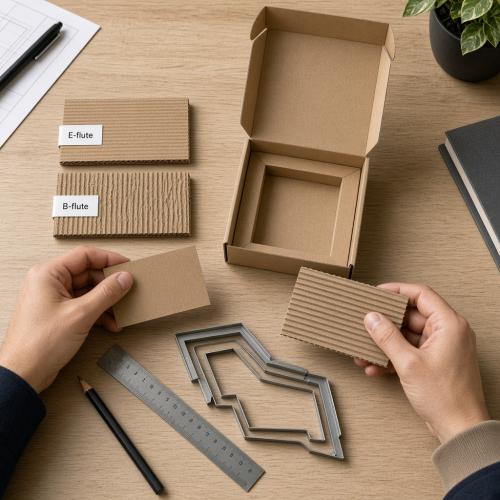
Kraft paper boxes usually have a smooth surface and clear printed text, suitable for displaying high-precision patterns and colors. However, the single-layer structure tends to deform under large vertical pressure, making it more suitable for lightweight gift box scenarios or low-to-medium stacking heights. Corrugated boxes, supported by the inner wavy layer, significantly enhance compression and impact resistance, but the presence of flutes causes slight surface unevenness, which has some impact on the reproduction of fine patterns. In addition, differences in die-cutting precision directly affect folding consistency: high-precision die-cutting gives even crease depth, resulting in sharp edges and smooth open/close after forming; die-cutting deviation may cause skewed boxes and poor lid fit, affecting overall texture and protection. In logistics, the cushioning of corrugated boxes effectively reduces damage from vibration or squeezing, but in high humidity, water absorption lowers its compression strength, whereas kraft paper has relatively better moisture resistance.
Application Scenarios and Understanding Framework
When choosing paper box packaging, it is recommended to build a judgment logic from the following dimensions: First, pay attention to the paper structure—clarify whether the product uses single-layer kraft paper or corrugated paper, and the flute type (fine flute suits printing, coarse flute suits heavy loads); second, check the precision description of the die-cutting process to understand whether it can ensure forming consistency in mass production; third, evaluate the application environment—if long-distance logistics or stacked storage is involved, the compression and cushioning ability of corrugated paper is more critical, while if display effect and fine printing are the focus, kraft paper or litho-laminated corrugated paper is more suitable; finally, consider customization needs such as text clarity and image-based custom printing, and confirm whether the paper surface characteristics match the printing process requirements.
Application Scenarios and Understanding Framework When choosing paper box packaging, it is recommended to build a judgment logic from the following dimensions: First, pay attention to the paper structure—clarify whether the product uses single-layer kraft paper or corrugated paper, and the flute type (fine flute suits printing, coarse flute suits heavy loads); second, check the precision description of the die-cutting process to understand whether it can ensure forming consistency in mass production; third, evaluate the application environment—if long-distance logistics or stacked storage is involved, the compression and cushioning ability of corrugated paper is more critical, while if display effect and fine printing are the focus, kraft paper or litho-laminated corrugated paper is more suitable; finally, consider customization needs such as text clarity and image-based custom printing, and confirm whether the paper surface characteristics match the printing process requirements.
If you want a shorter marketing-version translation or a polished bilingual layout for the packaging spec sheet, I can trim and reformat it.