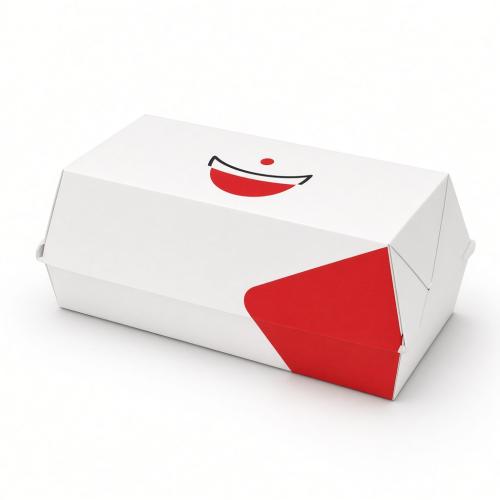
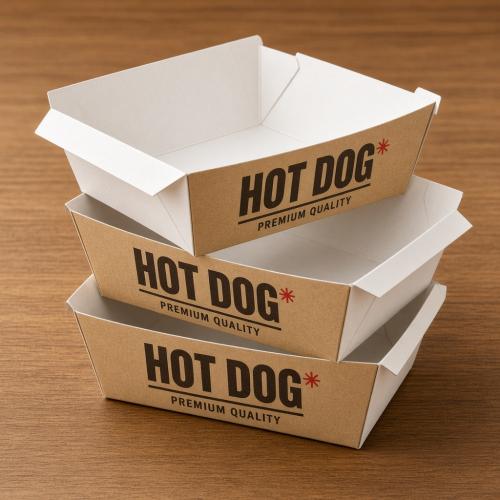
In the field of food packaging, the packaging boxes for ready-to-eat products such as strand hot dogs, starch sausages, and crispy roasted sausages are often evaluated mainly on dimensions, color, and visual style. However, the key factors that truly determine whether such paper boxes can be stably supplied in mass production and maintain structural integrity during end use are usually hidden in the processing technology and material selection. What many users easily overlook is that the same white cardboard, when processed with different printing and forming methods, will directly affect the oil resistance, stiffness consistency, and quality stability of batch delivery.
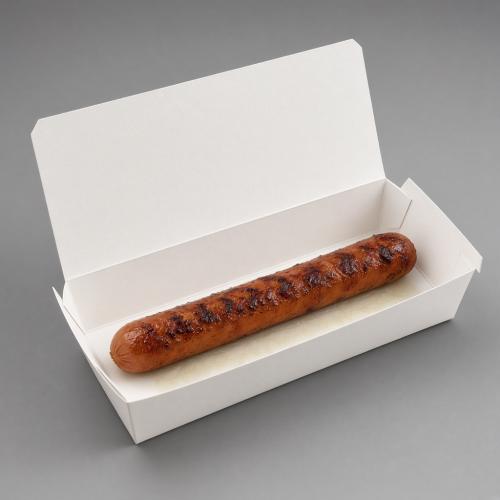
Working Principle and Core Structure Analysis
The core function of a strand hot dog packaging box is to hold oily hot dog sausages while keeping the box structure from collapsing during handling and eating. Such paper boxes usually use white cardboard as the base material, and its stiffness and surface treatment capability directly determine the support performance of the package. From a process perspective, flexographic printing (flexo) is one of the common printing methods for this type of product. Flexo uses an elastic relief plate, together with low-viscosity water-based or UV inks, and transfers ink quantitatively from an anilox roller to the plate and then onto the substrate. The advantage of this process is its adaptability to continuous mass production, with daily output exceeding 200,000 pieces, and strong adaptability to paper. The multi-layer fiber structure of white cardboard is subjected to relatively uniform pressure during flexo printing, making local deformation less likely—which is critical for subsequent die-cutting and gluing processes.
How Technical Differences Affect Practical Application
Although both are paper box packages, flexo differs significantly from offset and gravure printing in print precision, ink adhesion, and production efficiency. The screen ruling of flexo is usually lower than that of offset, so it is slightly less sharp in rendering fine gradients or small text, but for hot dog packaging boxes that mainly use large color blocks and simple logos, this difference is not obvious. What really affects end-use performance is the drying method and adhesion of flexo inks. After rapid drying, water-based flexo ink forms a relatively thin ink layer with shallow penetration into paper fibers, which helps maintain the original stiffness of the paper and avoids softening caused by excessive ink absorption. At the same time, flexo equipment can perform online operations such as varnishing and die-cutting, reducing work-in-progress handling, and lowering the risk of creases or edge wear during box transportation. For orders with high daily output requirements, the continuous inking system and automatic plate-changing capability of flexo effectively shorten production cycles and reduce inter-batch color deviation.
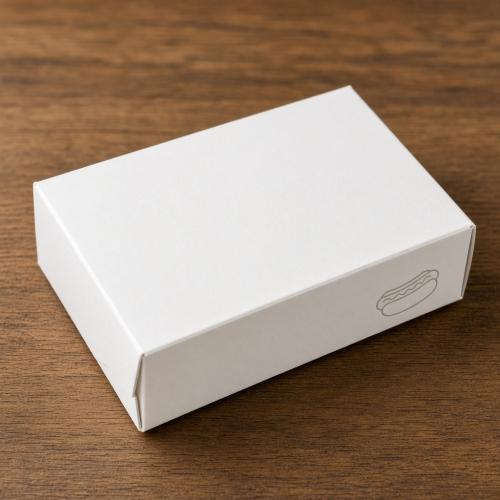
Application Scenarios and Evaluation Framework
When selecting strand hot dog packaging boxes, it is recommended to build a judgment basis from the following dimensions:
First, pay attention to the compatibility between printing process and paper—flexo is more suitable for large-volume orders with relatively few colors; if the packaging design includes high-precision graphics or small-size text, evaluate whether the flexo screen ruling meets requirements.
Second, understand the relationship between white cardboard gram weight and stiffness—the support performance of the box depends not only on paper thickness, but also on fiber orientation and calendering treatment. When customizing sizes, clarify whether the use scenario is handheld immediate consumption or takeaway delivery; the former demands higher box compression strength.
Third, check ink oil resistance—after heating, hot dog sausages release oil; if the ink layer cannot effectively block oil penetration, the box surface will show oil stains, hurting appearance and hygiene perception.
Fourth, consider the supply chain support at the production location—mature collaboration networks for anilox roller maintenance and die-cutting mold customization help shorten customization cycles and lower trial-and-error costs.