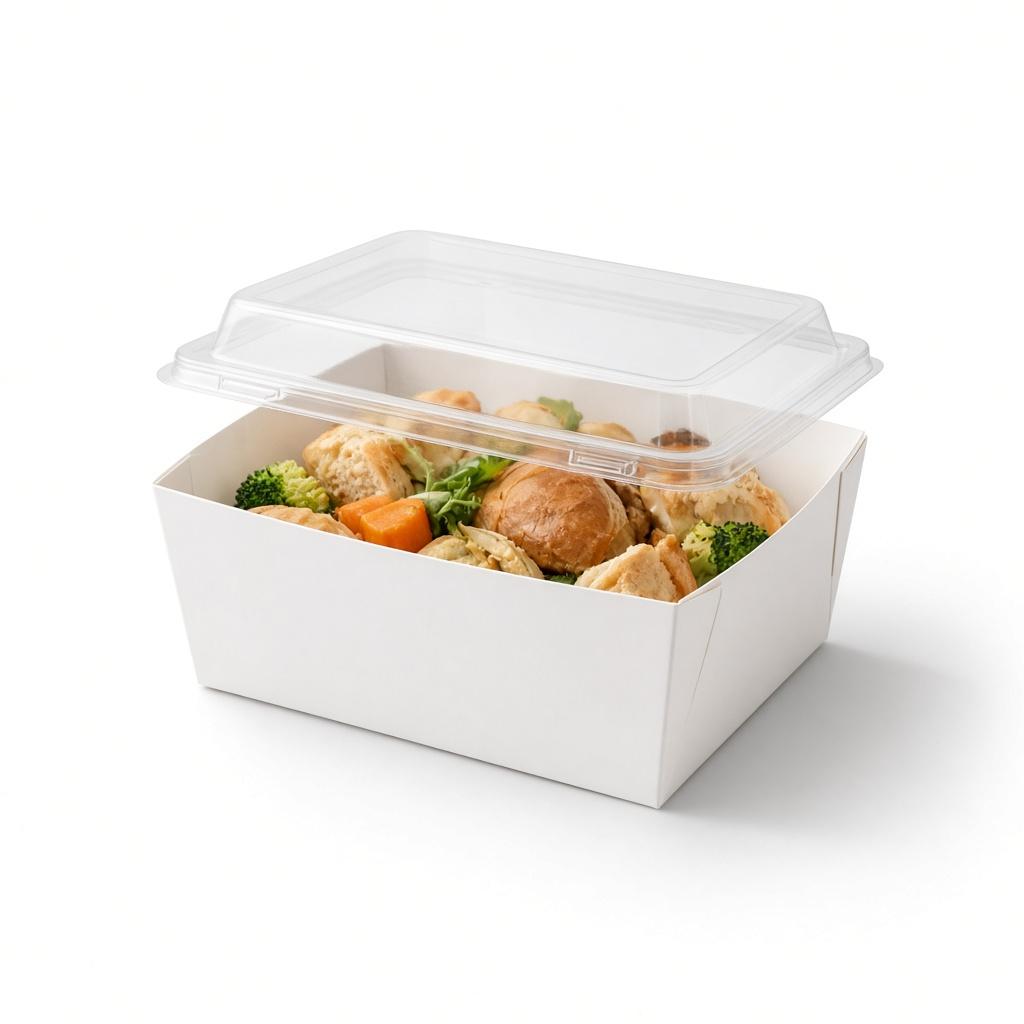
In food delivery and bakery retail scenarios, disposable paper boxes are among the most common packaging containers. When making selections, many practitioners often focus only on size and appearance, while overlooking details such as paperboard thickness, inner-wall smoothness, lid material, and bottom anti-slip design. These seemingly insignificant parameters actually determine the stability and user experience of the paper box during filling, transportation, refrigeration, and eating. Understanding the logic behind these designs helps practitioners make more reasonable judgments based on real needs.
Working Principle and Core Structure Analysis
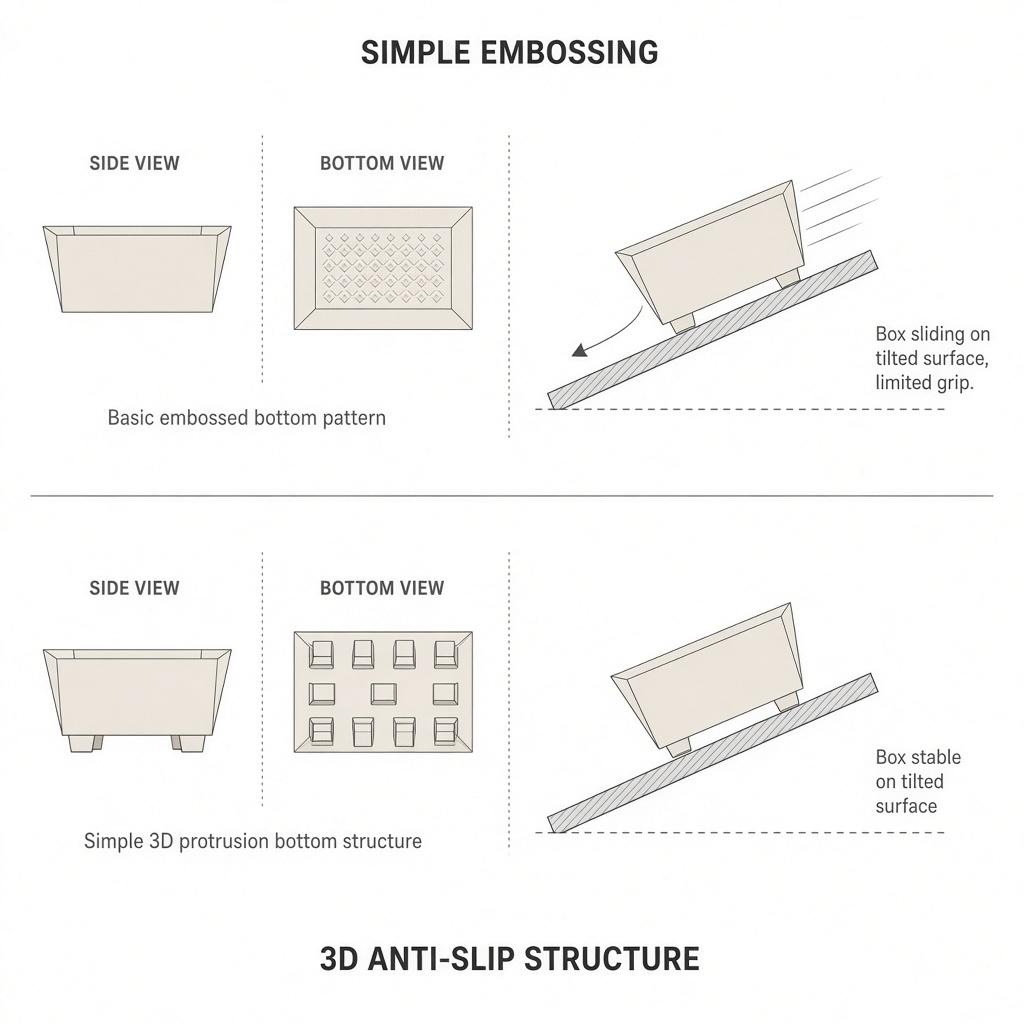
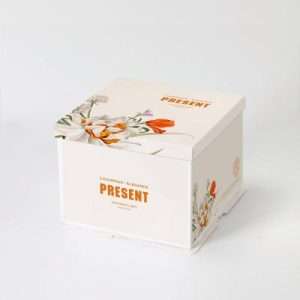
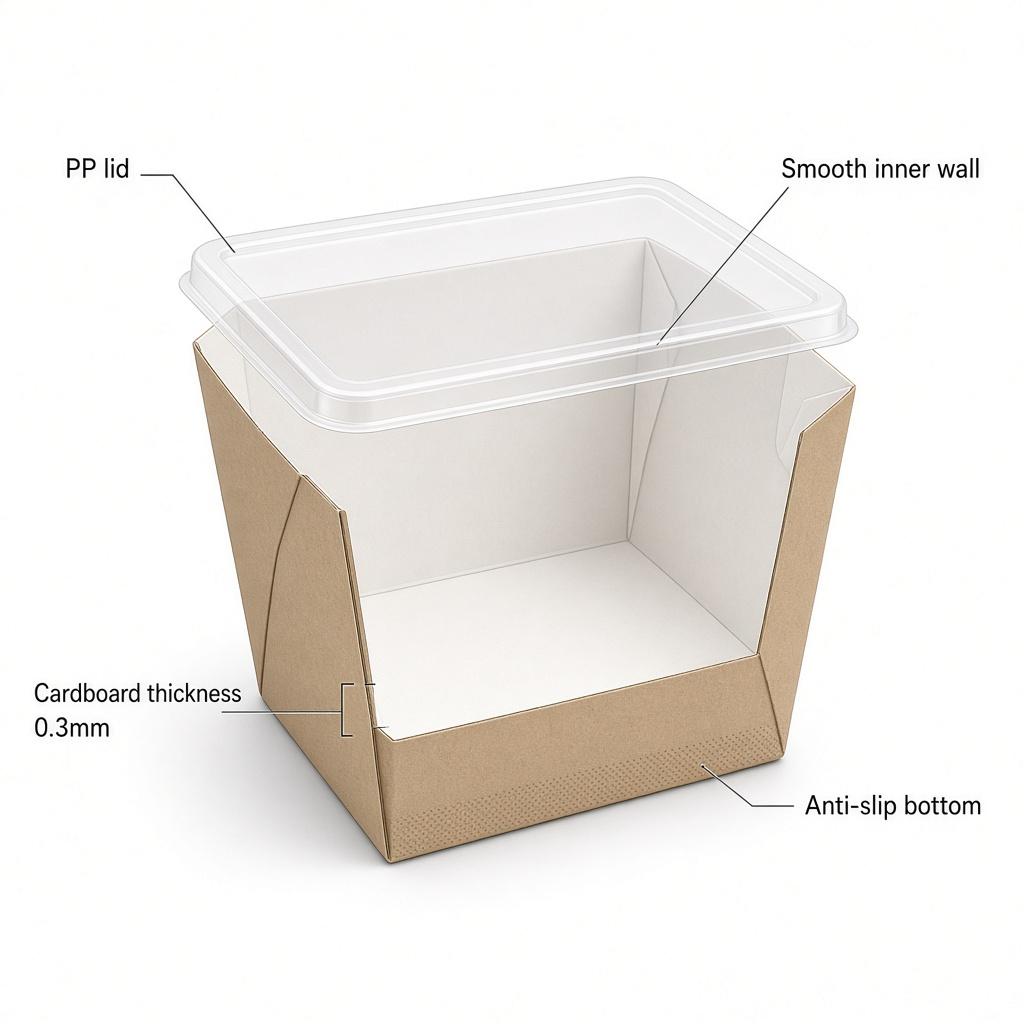
The core function of a disposable takeout paper box is to hold food and maintain its form. The main body is usually made of food-grade cardboard; thickness (e.g., 0.3 mm) directly affects compressive strength and stiffness—thicker cardboard better resists deformation from stacking and squeezing. The high-smoothness inner wall mainly reduces food sticking to the paper wall, making eating and cleaning easier, while also lowering the risk of oil or moisture penetration. Bottom anti-slip design is usually achieved by adding friction texture or structural protrusions, aimed at preventing the box from sliding when tilted or moved, which is especially important during delivery. The lid uses food-grade PP plastic (polypropylene), a common heat- and cold-resistant material with good sealing and some transparency for seeing the contents. Screen printing is used for simple patterns on the box surface; compared with offset or flexo printing, screen printing has a thicker ink layer and stronger adhesion, suits curved or irregular surfaces, and the pattern does not easily peel off.
How Technical Differences Affect Real Applications
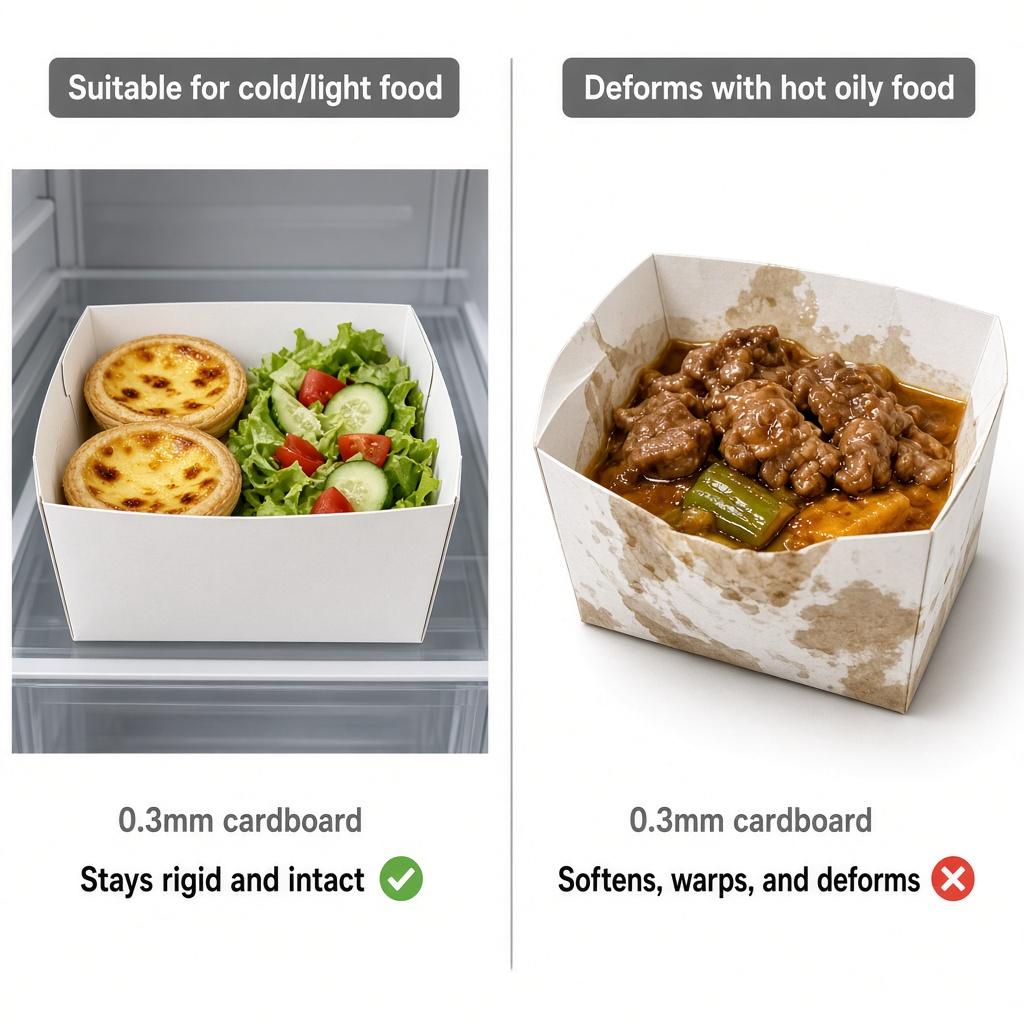
Paperboard thickness differences directly affect performance in cold-chain or hot-food scenarios. 0.3 mm is a medium-thin spec, suitable for light, dry, or short-time refrigerated foods (e.g., egg tarts, salad, chicken nuggets), but for hot food with high water or oil content, thinner board may soften from moisture absorption and lose structural strength. For lids, food-grade PP has better low-temperature performance than ordinary PET or PS, not becoming brittle or cracking under refrigeration, but its heat resistance is usually below 120°C, so it is not suitable for direct microwave heating or holding just-out-of-oven high-temperature food. Inner-wall smoothness affects food residue: a high-smoothness surface reduces sauce or oil adhesion, but without a special coating, long contact with acidic or oily food can still penetrate. Bottom anti-slip effectiveness depends on structure: simple embossing has limited effect, while 3D protrusions or recesses are more reliable. Screen printing’s advantage is pattern durability, but cost is higher and it does not suit multi-color gradients or high-precision images, so it fits batch printing of simple patterns.
Application Scenarios and Understanding Framework
When choosing disposable takeout paper boxes, consider these dimensions by scenario: First, food type and temperature—cold or room-temp food needs less board thickness and lid heat resistance; if refrigeration or short freezing is involved, confirm the box and lid have low-temperature resistance (e.g., this product is clearly marked refrigerator-safe). Second, delivery distance and method—long or bumpy delivery makes bottom anti-slip and lid sealing more critical, reducing shift or spill risk. Third, packaging and display needs—if stack transport or shelf display is needed, box stiffness and rounded edges affect stacking stability and neat appearance; screen-print wear resistance affects brand info longevity. Fourth, eco and cost balance—paper box + plastic lid must be separated for recycling, so if the business has green policies, evaluate recycling convenience of the material combo. Once these are understood, practitioners can check parameters against core pain points (leak-proof, cold-proof, looks, cost) instead of deciding by look or price alone.