Snap-lock boxes are lightweight, rigid telescopic (sky-and-earth) boxes are premium, and drawer boxes are practical—choosing the right packaging structure can improve user experience by 30%. Offset printing restores graphics, UV coating enhances abrasion resistance, hot foil stamping highlights details, and a 0.1 mm tolerance determines assembly success.
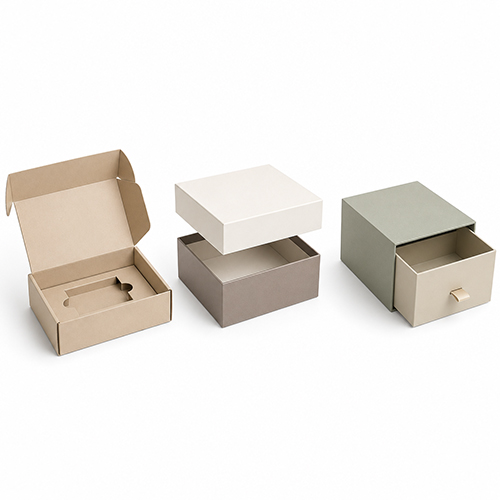
As the core carrier of product outer packaging, the differences in gift box design are mainly reflected in three dimensions: structural type, printing process, and material selection. These differences directly determine the protective performance, display effect, and production cost of the packaging, and are key factors that brands need to weigh when customizing.
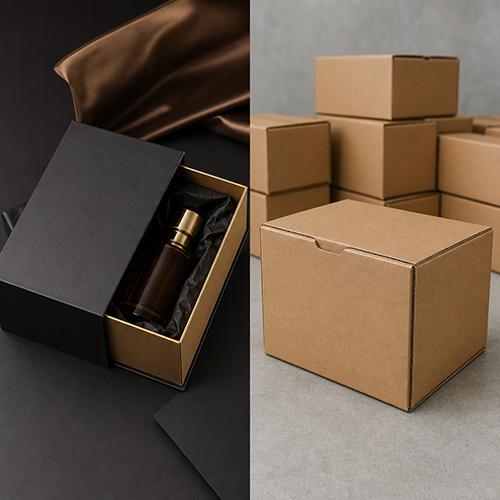
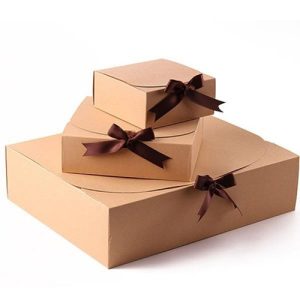
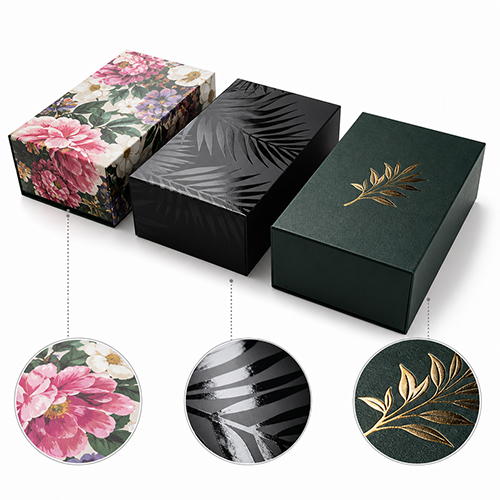
From a structural perspective, the snap-lock box relies on cardboard insertion to form a fixed structure, suitable for lightweight packaging; the rigid telescopic box achieves sealing through the closure of the top and bottom covers, mostly used for high-end gifts; the drawer box’s push-pull design facilitates repeated access. Different structures also have different requirements for paper weight—the choice of 210–350 g/m² paper needs to balance load-bearing capacity and forming effect. In terms of process, offset printing can achieve complex graphic restoration, UV printing improves surface abrasion resistance, and hot foil stamping is specifically used for local decorative enhancement.
The industry usually divides gift boxes into display-type and functional-type. Display-type focuses more on visual presentation, often using rigid telescopic boxes with hot foil stamping; functional-type emphasizes practicality and convenience, with drawer boxes and handle designs being more common. Multi-layer structures (such as 5-layer cardboard) strike a balance between protection and cost, and controlling dimensional tolerance within 0.1 mm is a key indicator for ensuring automated assembly.
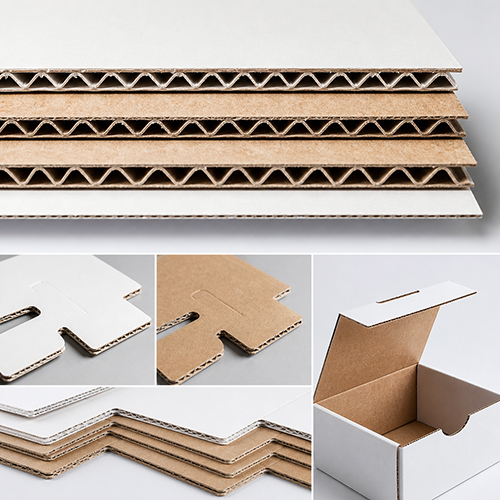
In practical applications, logistics packaging needs to prioritize compression resistance and mostly uses auto-lock bottom box structures; luxury packaging focuses on the unboxing experience, and rigid telescopic boxes with specialty paper are the mainstream solution. A daily production scale of 20,000 pieces means balancing process complexity and production efficiency, which is also why offset printing and digital printing each have their advantages in batch production.
In practical applications, logistics packaging needs to prioritize compression resistance and mostly uses auto-lock bottom box structures; luxury packaging focuses on the unboxing experience, and rigid telescopic boxes with specialty paper are the mainstream solution. A daily production scale of 20,000 pieces means balancing process complexity and production efficiency, which is also why offset printing and digital printing each have their advantages in batch production.